Introduction
Want to further your education but worried about the cost of university? You’re not the only one. In this blog, I’m going to look at the Student Loan in Pakistan 2026: the eligibility criteria, the documents required, the loan eligibility criteria, the documents required,
the lwould like nothing more than to get a degree from university but the cost of that can be a real barriersity but thtuition, the cost of the semester, books, hostetuition, the cost of the semester, books, hostel and day to day living ittudenbeho has td gradely’s budget.
Purpose to go to university. You can have a student who has the grades, but families don’t afford it; they just can’t afford it. There are education financing options worth exploring.
Certainty loans to eligible students, while the National Bank and the NBP have their own student loan schemes for those who qualify, there’s something important to understand.
Not every student qualifies for every loan, and not every education loan is interest-free. Some facilities are limited to particular universities, while others have specific academic, financial, and age requirements.
Student Loan in Pakistan 2026
In this guide, we look at three student financing options to consider in 2026: the MCB Student Personal Loan, the Askari Bank Education Loan, and the NBP Student Loan Scheme. We’ll cover eligibility, required documentation, loan amounts, repayment terms, and how to apply.
Let’s look at each option so you can decide which one is worth looking at in your circumstances.
Please note: Bank policies, financing rates, and application deadlines are all subject to change. Always check the relevant bank’s website for the most up-to-date information prior to applying.
What Is a Student Loan?
A student loan is a financial facility to help with certain education-related expenses. It will vary according to the lender but may cover tuition fees, admission fees, textbooks, accommodation (hostel), and so on. In Pakistan, students may well come across various forms of educational support.
- Education loans: These are generally provided by banks and must be repaid according to the agreed terms. Commercial loans usually include interest or markup.
- Interest-free student loans: Eligible students can receive financial assistance without conventional interest, provided they meet the scheme’s conditions.
- Scholarships and financial aid: universities and other bodies may be in a position to offer some form of assistance on the basis of academic merit or financial need. In some cases the funds may be non-repayable.
- University fees can be paid in installments rather than all at once.
Before you go any further, check whether repayment is in fact required and if so, how much it will cost. A scholarship will go a long way to alleviating your financial burden without the same repayment obligation as a commercial loan.
1. MCB Student Personal Loan 2026
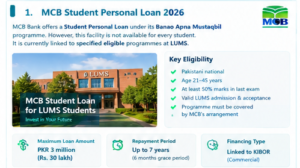
MCB has a Student Personal Loan under its Banao Apna Mustaqbil scheme. That facility is not available to all university students in Pakistan.
As per MCB’s published product information, the loan is linked to specified eligible higher education programs at Lahore University of Management Sciences (LUMS).
If you’re studying at a different university, then don’t assume you’re eligible. Always check the program requirements before you invest any time in preparing an application.
Who Can Apply for the MCB Student Loan?
MCB’s published eligibility criteria include the following conditions:
- The applicant must be a Pakistani national.
- The applicant must be between 21 and 45 at the time of loan or first tranche approval.
- The candidate must have obtained a minimum of 50% (or the equivalent) in the most recent public examination.
- The student must have valid admission and written acceptance from LUMS.
- The student’s program must be covered by the bank’s arrangement with the university.
Meeting those criteria doesn’t in any way guarantee that your application will be approved. The bank will of course be assessing your application in accordance with its own policies.
What Is the Maximum Loan Amount?
As per the MCB product page, the maximum loan amount is PKR 3 million (Rs. 30 lakh). That doesn’t mean that every eligible student will, in fact, get the full amount. The approved amount will depend on the educational expenses the facility will cover and the bank’s own assessment.
MCB also has an 80:20 financing arrangement for certain eligible fee components. Ask the bank to explain precisely how that works for your program and what your out-of-pocket figure will be.
Repayment Period and Other Charges
MCB’s published information states a maximum repayment period of 7 years (including a 6-month grace period). The rate of finance is tied to 6-month KIBOR. The rate and the amount repaid will, of course, vary, so get a written breakdown from the bank prior to taking out the loan.
Make sure you understand:
- The applicable markup rate.
- The monthly installment amount.
- Any processing or documentation charges.
- The total amount you’ll end up paying.
- The repayment schedule and the grace period conditions.
Knowing all of that in advance will help you to avoid any financial surprises down the track.
How to Contact MCB Bank
You can find further info via MCB’s own channels.
- Official website: MCB Student Personal Loan
- MCB helpline: 111-000-622
- Published consumer helpdesk: 042-35987979
Check the bank’s website for the most up-to-date contact details and program requirements prior to proceeding.
2. Askari Bank Education Loan 2026
Askari Bank also has an Education Loan for eligible students to help with the costs of higher education. The published product information applies to students enrolled in eligible HEC-recognised educational, technical or professional institutions in Pakistan.
Being enrolled in such an institution does not in itself guarantee approval. The bank may also look at your documentation, your financial situation, your credit history, and any other relevant criteria.
Askari Bank Education Loan Eligibility
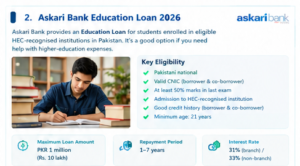
According to the bank’s published criteria, applicants generally need to meet the following requirements:
- The applicant must be a Pakistani national.
- The borrower and co-borrower must have valid CNICs.
- The student must have obtained at least 50% in the most recent board or university examination.
- The student must have valid admission to an HEC-recognised educational, technical, or professional institution.
- The borrower and the co-borrower must satisfy the bank’s credit history criteria.
Askari Bank requires both the borrower and co-borrower to be at least 21 years old. If you’re a student with no regular income, then you should contact the bank prior to applying to see if a parent, guardian, or another co-borrower can meet the relevant financial criteria.
How Much Can You Borrow?
Askari Bank’s published Education Loan product has a maximum amount of PKR 1 million (Rs. 10 lakh). The facility can cover the cost of scheduled tuition, boarding, and all other approved expenses as per the relevant fee challan.
As per the published information, the disbursement is made directly to the institution via the applicant’s account. The amount you will receive will depend on the eligible expenses and the bank’s own assessment.
Interest Rate and Repayment Period
Askari Bank’s published product information states a repayment term of 1 to 7 years (subject to applicable regulations and bank approval). The published pricing is 31% for branch customers and 33% for non-branch customers.
These are the figures that should be checked directly with the bank prior to applying, as the rates and terms are liable to change.
The published information makes no mention of any processing fee and makes no mention of any early termination charges. Other charges (such as late payment, legal and documentation charges, etc.) will of course be applicable in accordance with the current schedule of charges.
Don’t pick a loan on the basis of the maximum amount available. You need to be able to afford the repayments, particularly if you’re still in education and don’t have a regular income.
Documents Required for Askari Bank Education Loan
The bank lists the following among its main application requirements:
- Completed loan application form.
- Valid CNIC.
- Salary slip or salary certificate.
- Six-month bank statement.
- Employment contract (where applicable for contractual employees).
- Admission proof and relevant academic documents.
Depending on your circumstances, the bank may ask for further documentation.
How to Apply for Askari Bank Education Loan
If you think you meet the requirements, here’s how to get started:
- Check that your institution and program are eligible.
- Contact Askari Bank and get the latest application form from them.
- Get your CNIC, admission letter, fee challan, and all the requisite financial documents ready.
- Just submit the application via the bank’s approved process.
- Check the markup rate, the repayment schedule, and all the other charges before you sign the agreement.
Official source: Askari Bank Education Loan
3. National Bank of Pakistan Student Loan Scheme 2026
For students looking for an interest-free education finance option, the National Bank of Pakistan Student Loan Scheme is worth looking at. NBP refers to this as an interest-free facility for eligible students who are in financial difficulty whilst studying in certain fields of higher education at approved public sector universities and colleges.
However, there is a difference between a scheme that exists and one that is currently taking applications. The NBP published information contains material from previous academic sessions. Students who are intending to apply in 2026 should therefore first get in touch with the bank to confirm whether a new application cycle has been launched.
Who Is Eligible for the NBP Student Loan Scheme?
The published scheme criteria include the following:
- Admission on merit via the normal admission process.
- Enrolment in an approved public sector university or college.
- An age limit of 21 at admission for the graduation programs.
- An age limit of 31 on admission to the PGR programs.
- An age limit of 36 on admission for PhD programs.
- At least 70% in the most recent public exam.
- Enrolment in an approved area of study.
- Financial need that would prevent the student from going to university without assistance.
The scheme also contains conditions relating to other scholarships and forms of financial assistance. You must read the official rules very carefully to ascertain whether you are in fact eligible.
Which Subjects Are Covered?
NBP’s published scheme information lists several approved fields of study, including:
- Engineering and electronics.
- Oil, gas and petrochemical technology.
- Agriculture and medicine.
- Physics, chemistry and the other natural sciences.
- Biology, molecular biology and genetics.
- Mathematics.
- Computer Science, Information Systems and Technology.
- Economics, statistics, and econometrics.
- Business Management Sciences and Commerce.
- Dawah and Islamic jurisprudence under the various Sharia-related law programs.
Not every degree program is necessarily covered. Always check the approved university list and subject requirements before assuming that your course is in fact covered.
What expenses can the NBP scheme cover?
Under the published scheme, eligible expenses include:
- Scheduled educational fees.
- Boarding (excluding meal charges).
- Textbooks.
The payment process will vary depending on the type of expense and the rules of the scheme. Some amounts will be paid directly to the university or college, and some approved textbook costs will be paid to the student.
NBP Student Loan Repayment Terms
The NBP published scheme information states a maximum repayment period of 10 years from the date of disbursement of the first installment.
Under the published terms, repayment starts six months after the first date of employment or one year after the completion of studies, whichever comes first. As those details are taken from the published Scheme Terms, make sure they still stand when a new application round is announced.
How to Apply for the NBP Student Loan Scheme
Interested students should follow these steps:
- Go to the NBP official Student Loan Scheme website.
- Look for a current application announcement.
- Check the most up-to-date eligibility criteria and the list of approved institutions.
- Download the application form if applications are open.
- Follow the instructions for submitting your documents via the nominated branch or via any other approved channel.
Official links:
If you can’t locate a current application announcement, then get in touch with NBP and ask them whether applications are due to open. Don’t just go on an old advert or assume that applications are open simply because the page is still up.
4. Student Loan Options in Pakistan Compared
Not sure which one you’re going to go for? This comparison gives you a quick rundown of the main published features.
| Published maximum amount | PKR 3 million | PKR 1 million | According to scheme rules |
| Main eligibility scope | Specified eligible LUMS programs | Eligible HEC-recognised institutions | Approved public-sector institutions and subjects |
| Minimum marks | 50% | 50% | 70% |
| Published repayment period | Up to 7 years | 1–7 years | Up to 10 years |
| Financing type | Commercial financing linked to KIBOR | Commercial financing | Described by NBP as interest-free |
| Application availability | Confirm with MCB | Confirm with Askari Bank | Check for a current application round |
Remember these are published product details and not a guarantee that you will qualify. The actual amount, the terms of repayment, and the availability will be subject to the rules in force with the relevant institution at the time.
5. Documents You Should Prepare Before Applying
Get your paperwork together as early as possible, as this will make the application process far less stressful. The specific requirements will of course vary, but the following list is a good starting point.
Personal Documents
You may need:
- Valid CNIC.
- Recent photographs, if requested.
- Current contact details and residential address.
- CNIC copies of a parent, guardian, or co-borrower, where applicable.
Educational Documents
Keep these documents ready:
- University or college admission letter.
- Student identity card, if available.
- Previous examination certificates and mark sheets.
- Current fee challan / official fee structure.
- Proof of institutional recognition or inclusion on an approved list (where required).
Financial Documents
Depending on the bank or scheme, you may also need:
- Recent bank statements.
- Salary slip or salary certificate for the borrower or co-borrower.
- Employment contract or other proof of income.
- Details of existing financial obligations, if requested.
Before you submit anything, check your docs against the lender’s most recent checklist. A fully completed application can go a long way to avoiding delays, but no guarantee of approval is ever going to be given.
6. How to Apply for a Student Loan in Pakistan: Step by Step
If you’re planning to apply for an education loan in 2026, take the process one step at a time.
Step 1: Work Out How Much Money You Need
Start with your actual education expenses (tuition fees, admission fees, textbooks, hostel accommodation, etc.). Ask your university for an official fee structure so that you can work with actual figures rather than estimates.
Step 2: Check the Eligibility Requirements
Read the lender’s criteria very carefully. Look at the minimum marks, the age limits, the list of eligible universities, the income requirements and the credit history rules. If anything is still unclear, then please contact the bank prior to you collecting all your documents.
Step 3: Compare Loan Terms
Don’t jump at the first offer you come across. Get a full breakdown from each lender as to the maximum amount, the markup, the repayment period, the monthly installments, the processing charges and the guarantor requirements.
also check whether a grace period is on offer and what happens if you miss a payment or if you pay it off early. These details will go some way to telling you what the real cost of borrowing is.
Step 4: Collect Your Documents
Get your CNIC, admission letter, fee challan, academic transcripts, and any other required financial documents ready. Check whether the bank requires the original docs, photocopies, certified copies, or a particular application form.
Step 5: Submit Your Application
Apply via the bank’s website, branch, or another approved channel. Don’t send any of your sensitive documents to anyone you don’t know or to any unverified social media account.
Step 6: Read the Agreement Carefully
Before you sign, make sure you understand the total amount you’ll be repaying, the installment schedule, the applicable markup, the fees, and the conditions in the event of a missed payment.
If you don’t understand a particular clause, then ask the bank to explain it. It’s far better to have it clarified before you sign than to find yourself facing an unexpected cost later on.
Step 7: Keep Copies of Everything
Save your application, supporting documents, the approval letter, the financing agreement, and the payment receipts. These records will assist you in tracking your application and your repayment obligations.
7. Things to Consider Before Taking a Student Loan
Getting financial assistance with your education can be a real relief when you’re facing fees. That said, taking out a loan is a very serious thing to do, so you do need to take a bit of time to consider the following points.
Think About the Total Cost, Not Just the Loan Amount
A big loan may appear very attractive at first glance, but it can also mean larger installments and a significantly higher total repayment. Borrow only what you actually need and work out exactly how much you’ll be repaying over the full term.
Find Out Whether You Need a Guarantor
Some loans will require a parent, a guardian, a co-borrower, or some other acceptable form of financial support. It’s important to check this early on so you know what the requirements are.
Look for Scholarships Before Borrowing
Before you go for a commercial loan, check whether your university offers need-based financial aid, merit scholarships, fee concessions, or an installment plan. You might be able to reduce the amount you actually need to borrow, or indeed you might be able to avoid borrowing at all.
Be Careful of Loan Scams
Don’t fall for anyone who’s going to guarantee you approval in return for an upfront fee. Always get in touch with the bank yourself and use their own application process.
Give Accurate Information
Ensure your application has the correct personal, academic, and financial details. If you’ve got false information or altered documents, then you’re likely to be rejected, and there could be other repercussions as a result.
Confirm That Applications Are Open
An online product page doesn’t in any way mean that a loan is available to new applicants at that moment. Always check the most up-to-date application dates, terms and conditions before you make any plans.
Frequently Asked Questions (FAQs)
1. Can I get a student loan of Rs. 10 lakh in Pakistan in 2026?
Potentially yes. Askari Bank’s published Education Loan product has a maximum financing amount of PKR 1 million (Rs. 10 lakh). Approval is subject to your eligibility, the documentation you submit, and the bank’s own assessment.
2. Can I get Rs. 30 lakh for my education?
MCB’s published Student Personal Loan has a maximum of PKR 3 million (Rs. 30 lakh). It is, however, linked to specific eligible programs at LUMS and so is not available to all university students in Pakistan.
3. Is the NBP student loan scheme interest-free?
NBP describes its Student Loan Scheme as interest-free. You should check whether applications are currently open and check the official terms before applying.
4. Can I apply for a student loan if I’ve got no job?
It will depend on the lender and your circumstances. Askari Bank lists salary proof as one of its primary requirements. Some of their products will look at the financial position of a parent, a guardian or a co-borrower. Get in touch with the bank to find out what they will accept.
5. Do I need a guarantor to get an education loan?
Not in all cases. It will vary from product to product. Some lenders will require a guarantor or co-borrower, so it’s worth checking with the bank what their requirements are prior to applying.
6. How long does it take to get a student loan approved?
There is no single timeline for every bank. The processing time will vary from lender to lender, will depend on the level of document verification required, will depend on the completeness of your application, and will, of course, depend on any further checks that the bank may wish to carry out. Always ask the bank for a timescale when you submit your application.
7. Can students at private universities apply for the NBP Student Loan Scheme?
The NBP scheme as published is based on the approved list of public sector universities and colleges. If you’re studying at a private institution, you’ll need to check the current scheme rules and the current list of approved institutions before you assume you’re covered.
8. Will my student loan be approved if I submit all the required documentation?
No, the paperwork is absolutely vital, but the lender still has to check your eligibility, check the docs, and assess the application in accordance with their own policies.
9. What can I do if I can’t afford a commercial education loan?
Start with university scholarships, need-based financial aid, fee concessions, and installment plans. Those may well be the way to keep going with your studies without incurring a massive amount of debt which you’ll then have to repay.
Conclusion
Paying for uni can be a real problem, but there are a number of options for funding your education in Pakistan that you should look into. The one you end up going down will, of course, be down to your particular university, your record, your finances and your ability to repay.
MCB’s Student Personal Loan is linked to specific eligible programs at LUMS. Askari Bank has an Education Loan for eligible students at recognized institutions. NBP has a separate student loan scheme which is interest-free (with its own academic and financial criteria).
These facilities operate in a different way, and not every student will be eligible. The current availability, the terms of finance, and the eligibility criteria should always be confirmed via the official source.
If you’re planning to apply in 2026, start by calculating your education expenses, checking your eligibility, and comparing the full repayment costs. It’s also worth exploring scholarships and university financial aid before taking a commercial loan.
Remember, the goal isn’t simply to get the largest amount of money possible. It’s to find a funding option that helps you finish your education without leaving you with repayments that become difficult to manage.
Are you planning to apply for a student loan in Pakistan, or are you looking for financial assistance to continue your studies? Share your questions in the comments, and check the official bank links above for the latest application details.
Editorial note: Loan amounts, interest or markup rates, eligibility requirements, and application availability can change. This article is for general informational purposes only. It does not guarantee loan approval or constitute financial advice.

[…] to the official CM Punjab Laptop Program […]
[…] the better option for you. Salaried / business people with a stable income can look at the federal program. [Internal link: link your website’s Apni Chhat Apna Ghar article here] [Internal link: link the […]